Climate change in Ukraine: we can’t do without irrigation

Climate Change and Agriculture
These are two interconnected processes of a global scale. Global warming influences a range of agricultural parameters, including changes in average temperatures, variations in rainfall patterns, fluctuations in atmospheric concentrations of carbon dioxide and ozone, the emergence of new pests and diseases, and shifts in food quality.
Climate change has never been as rapid as it has over the last 30 years. The last four years have been the hottest in the history of meteorological weather observations worldwide. In Ukraine, the average annual temperature has increased by 1.2°C over the past thirty years. The rate of air temperature rise in Ukraine outpaces global trends; as a result, droughts in Ukraine are intensifying and expanding, accompanied by an increase in land areas prone to desertification.
Drought is a natural phenomenon driven by atmospheric circulation processes, characterized by a prolonged absence of precipitation (or a significant reduction compared to long-term averages) combined with elevated air and soil temperatures, as well as high winds.
Starting from 1991, each subsequent decade has been warmer than the previous one: 1991–2000 — by 0.5°C, 2001–2010 — by 1.2°C, and 2011–2019 — by 1.7°C.

The moisture level was evaluated based on the following criteria:

Aridity Level in Ukraine
In Ukraine, the average annual precipitation for the baseline period of 1961–1990 (the norm) is 578 mm. Over the period of 1991–2017 (compared to the baseline period of 1961–1990), a redistribution of precipitation across Ukraine’s regions and seasons occurred. Overall, the total annual amount of precipitation has not changed drastically, but shifts are occurring in the intensity and nature of rainfall: for instance, half of the monthly norm or a full month’s worth of rain can fall within a few hours. This leads to an increased frequency and intensity of extreme weather events (specifically, floods and droughts).
Furthermore, in certain regions of Ukraine, the average annual precipitation has decreased relative to the norm, and territories with insufficient rainfall (less than 400 mm) during the warm period are gradually expanding. Thus, the climate across the entire territory of Ukraine has overall become more arid. In recent years, droughts have been observed in regions where they did not previously occur, necessitating soil irrigation and prompting a search for the most efficient and economically viable methods. One such method is drip irrigation.
Recommendations for Minimizing the Impact of Droughts
The most radical means of combating drought phenomena, particularly soil droughts, is field irrigation. Under current climatic conditions, Ukrainian farmers cannot manage without implementing efficient and modern irrigation systems, including drip irrigation. If choosing traditional sprinkler irrigation, it brings more “cons” than “pros”. The consequence of the long-term application of this type of irrigation can include soil degradation, secondary salinization, loss of calcium, and structural deterioration. Sprinkler systems cannot be used on uneven fields, use water uneconomically, cannot operate during strong winds, and increase the risks of plant diseases, among other issues. However, despite all the drawbacks of this method, it remains a genuine lifesaver for farmers in the south, accounting for over 90% of irrigated areas.
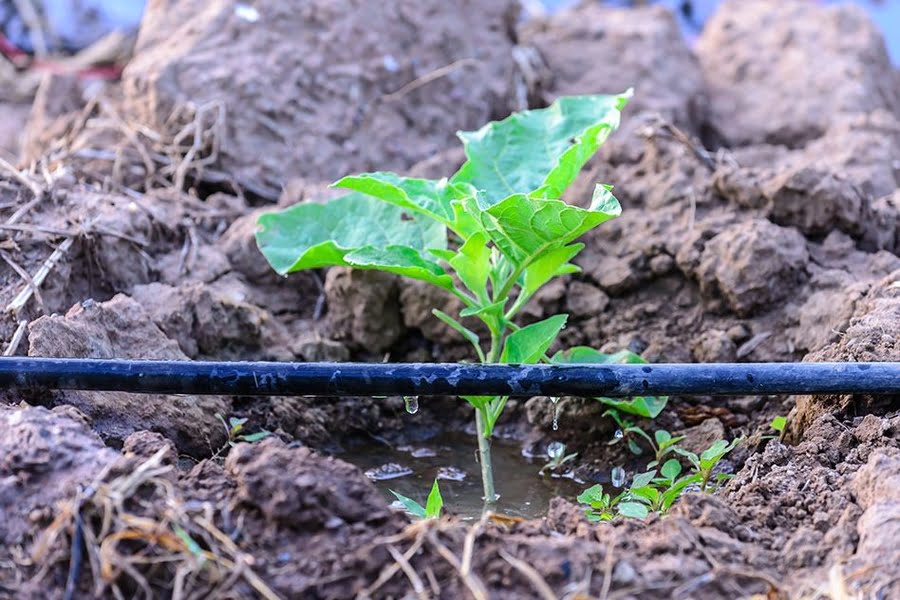
Unlike surface irrigation, a drip irrigation system delivers significant water savings and lower irrigation rates, a reduction in moisture loss through evaporation, prevention of surface water runoff even under complex topographical conditions, the ability to work in the field during irrigation, fertilizer application directly to the root system, better seed germination, a higher and more uniform yield, superior product appearance, no risk of soil salinization, and a reduction in weed count.
Consequently, today an increasing number of agricultural enterprises, especially in southern Ukraine, are investing in the construction of modern irrigation systems. As a company that counts the production of drip irrigation pipes among its core business lines, we have noticed a clear trend in recent years—each year we sell more polyethylene water pipes to agricultural enterprises specifically for building irrigation networks. For the construction of modern irrigation systems, polyethylene pipes are typically used, which is unsurprising given their significant advantages over other pipe types.

Advantages of Polyethylene Pipes:
- Low cost (compared to pipes made from alternative materials). When constructing water pipelines from polyethylene pipes, costs are cut by approximately 40% compared to building pipelines from other materials;
- High wear resistance (service life of up to 100 years);
- Not susceptible to corrosion;
- Resistant to water hammer and mechanical overloading;
- Require virtually no technical maintenance;
- Made from a chemically stable material; the internal surface of the pipe does not release any harmful impurities into the water;
- The welded joints at pipe connections are exceptionally reliable;
- Plasticity, meaning a technical polyethylene pipe will not burst if water freezes inside it;
- Frost resistance (the pipe withstands temperatures down to -40°C);
- Lightweight, requiring fewer specialized transport vehicles during delivery;
- Environmentally safe and non-toxic, releasing no harmful substances or impurities into the environment;
- Do not require cathodic protection.

For over 18 years, LLC “Planet Plastic” has been a manufacturer of polyethylene pipes. We produce polyethylene pipes from European raw materials on modern German extrusion machinery. Our polyethylene pressure pipes for water are manufactured in compliance with DSTU standards and hold quality certificates. Our polyethylene pipes undergo laboratory testing and verification of their physical and mechanical properties. Our manufacturing process meets international quality standards, and finished product quality control is conducted according to international ISO and ASTM methodologies.
Furthermore, polyethylene pipes manufactured by LLC “Planet Plastic” are safe for human health and the environment, as confirmed by an international environmental certificate. All our products have successfully passed environmental certification, receiving environmental certificate No. UA.08.002.515 and the right to use the environmental label under a scheme compliant with ISO 14024.
You can purchase high-quality polyethylene water pipes on our website under the “Pipes for Water Supply” section, or by calling our managers at +38 (044) 229-00-00.
To learn how to determine with the naked eye whether a pipe is high-quality or not, read our article “Polyethylene Pipes for Water Supply”.