FAQ. Answers to frequently asked questions about greenhouse film
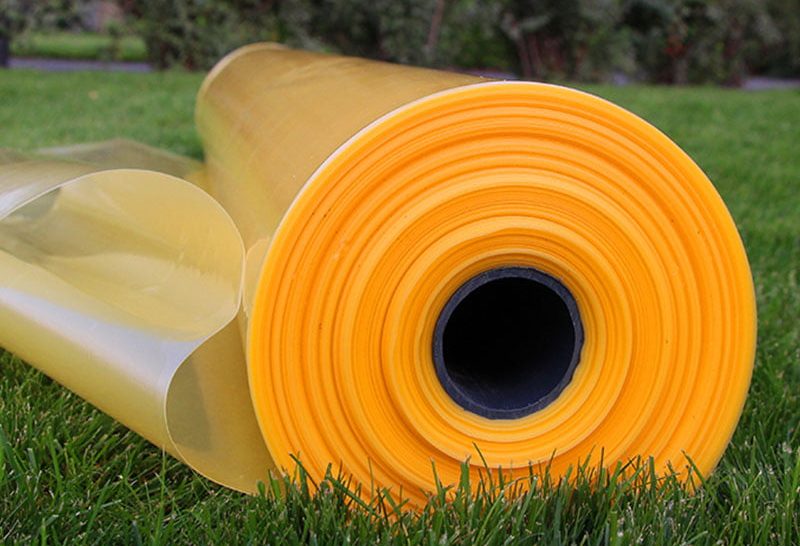
Polyethylene film possesses many properties that make it highly useful as a greenhouse covering. Its low cost, large sheet size, ease of attachment, and excellent light transmission are properties that have helped expand its utilization. Consequently, today approximately 90% of all greenhouses are covered with film, making it the most widespread material in greenhouse construction.
Polyethylene film was first used to cover wooden greenhouse frames back in the early 1960s. Since then, the film formulation, its properties, and production technology have been significantly improved. Legacy films lacked durability and had to be replaced annually. They could not withstand friction against the greenhouse frame or severe weather conditions. They also exhibited a short service life due to degradation from the sun’s ultraviolet rays.
Below, our process engineer answers frequently asked questions about greenhouse films, detailing their performance characteristics and explaining why greenhouse films require light stabilization, anti-fogging properties, multi-layer structures, and more.
What is a stabilized greenhouse film, and how is this light stabilization achieved?
The service life of polyethylene films is limited due to degradation processes triggered by solar radiation and heat. A stabilized film is a film into which an ultraviolet (UV) light stabilizer has been incorporated. Ultraviolet stabilizers are added to protect the film structure from the destructive effects of solar radiation and to minimize film degradation. The greater the amount of UV stabilizers included in the film formulation, the longer its service life. A film without UV stabilizers will fail within just a few months (4–6 months depending on the film thickness).
Why do greenhouse films come in different colors? How do film color and thickness affect transparency?
For instance, our UV series greenhouse films—which are professional three-layer greenhouse films—are available in yellow, green, pink, and blue colors. This is primarily done for consumer convenience, allowing users to distinguish how many seasons a film is designed to last based on its color indicator. Therefore, when choosing our film in a store, a consumer can easily determine by color that a yellow film is guaranteed to last 2 seasons (12 months), green for 4 seasons, pink for 6 seasons, and blue for 10 seasons (5 years). Concurrently, the color of the film—or more precisely, the color pigment and film thickness—in no way affects the transparency of the film or its light transmission and diffusion properties.
High light transmission is absolutely essential for plant growth. Our manufacturing experience, equipment quality, and raw material selection guarantee that our greenhouse films feature maximum light transmission capabilities (no less than 90%). Regardless of our film’s color, solar energy is transmitted equally through the greenhouse covering to the plants, driving the process of photosynthesis.
Light diffusion: why is it necessary in a greenhouse film?
Direct solar radiation (non-diffused light) can cause a “shadow” effect and result in “sunburn” on plants. Special light-diffusing additives induce the scattering of direct light and prevent shadow formation. Light diffusion enhances photosynthetic efficiency by ensuring more uniform light delivery from all sides, which is highly advantageous when cultivating self-shading crops such as cucumbers, tomatoes, zucchini, roses, and others. Furthermore, studies have demonstrated that diffused light reduces the development of fungal spores and limits the propagation of insects.
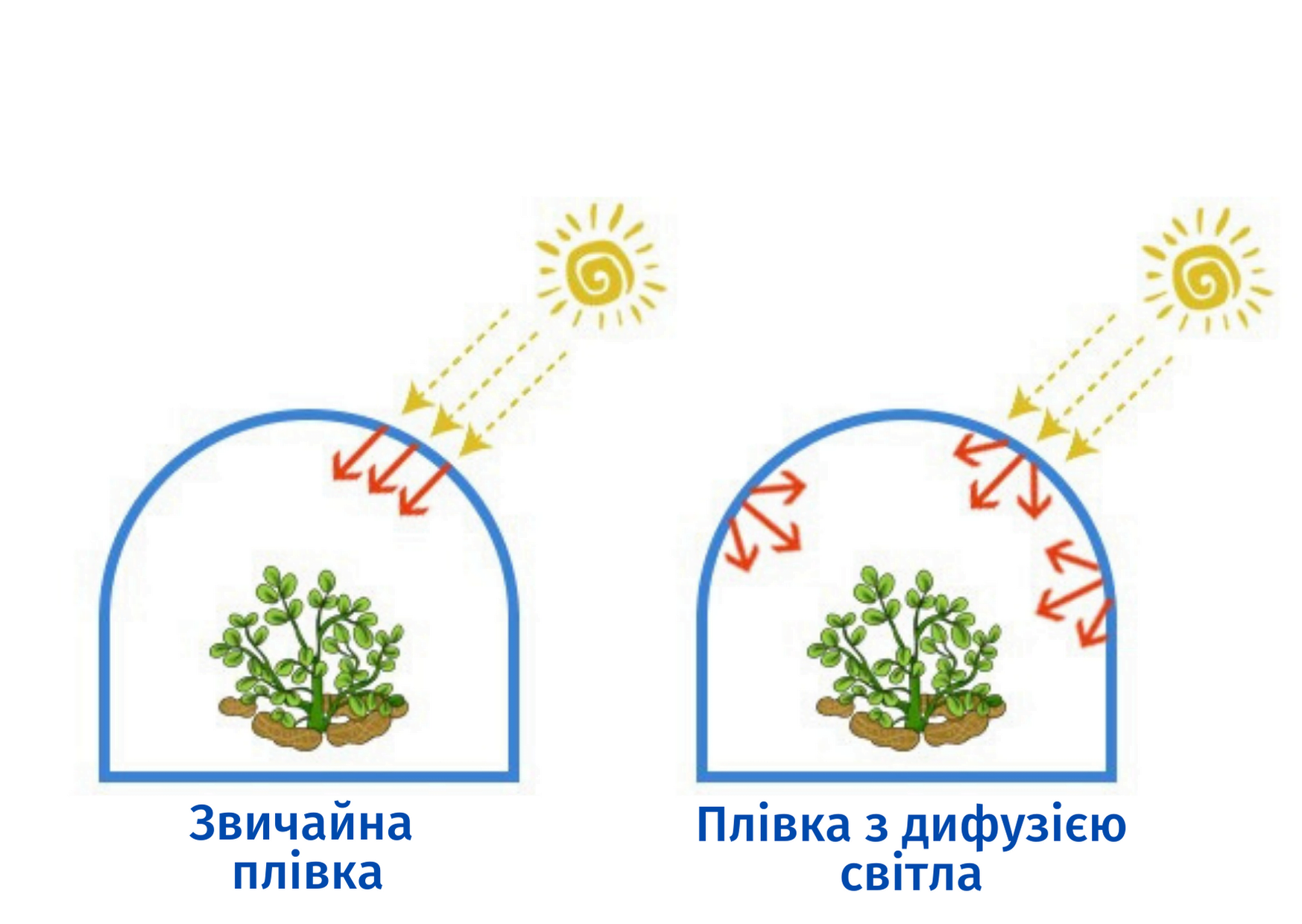
Solar light passing through a greenhouse film and entering the structure is split into direct and diffused components. Light diffusion gives the film a hazy appearance, but this does not mean the film is less transparent or possesses inferior light transmission compared to conventional greenhouse films. The PAR (Photosynthetically Active Radiation) received by the plants remains practically identical. It is now universally acknowledged that diffused light positively influences plant growth, particularly for spring and summer crops and in regions experiencing intense solar radiation.
Light diffusion minimizes shadows and ensures a more uniform distribution of light within the greenhouse, allowing it to reach even the lower sections of the plants, preventing scorching, and exerting a moderate cooling effect.
What is a multi-layer film, and can you see these layers? What is the difference between a multi-layer and a single-layer greenhouse film?
Greenhouse film can be either single-layer or multi-layer. Multi-layer greenhouse films are typically utilized for large-scale professional greenhouse complexes. Most modern polyethylene greenhouse films are manufactured using the co-extrusion method, combining several layers with distinct polymers and additives. This means that during production, specific components can be added into each individual film layer to impart targeted performance characteristics.

Consequently, each layer provides unique characteristics to the film, maximizing its efficiency through successful synergy with the other layers. Thus, a multi-layer greenhouse film is typically more durable at a lower thickness and correspondingly lower weight than a single-layer alternative. It is impossible for an ordinary consumer to visually distinguish these layers in the finished product.
Our experience, meticulous selection of raw materials, optimized processing conditions, and quality control procedures endow our greenhouse films with outstanding mechanical strength.
We have engineered a new generation of multi-layer, heavy-duty UV series greenhouse films utilizing specialized high-strength polymers. These films deliver enhanced operational security in regions subject to very high wind loads, as well as significant cost savings, since they feature lower thickness and weight than conventional films while maintaining identical or even superior mechanical strength.
Does greenhouse film transmit ultraviolet light?
Yes, our greenhouse film transmits a specific spectrum of ultraviolet light energy required for optimal plant growth and honeybee navigation. This is highly important, as solar radiation is necessary for plant photosynthesis and can also help control certain fungal plant diseases.
What is an anti-fogging or anti-dripping greenhouse film additive, and how does it function?
Warm air can hold more moisture than cold air. At night, the temperature inside the greenhouse drops, causing water vapor in the air to condense and form small, discrete droplets. This condensation fog effect results in:
- Reduced light transmission through the film;
- Water dripping onto plants, which can trigger diseases.
To prevent these situations, special additives are incorporated into the film during production. These additives modify the surface energy of the film, reducing the surface tension of water droplets so that the condensing water flattens into a continuous, invisible layer of liquid. Consequently, the condensate flows smoothly down the greenhouse walls instead of forming dripping droplets.
Is greenhouse film damaged when it comes into contact with a hot metal greenhouse frame in summer?
During the summer, a greenhouse frame can heat up to a temperature of 60°C; is an additional technical insulation strip required between the film and the frame? The melting point of polyethylene exceeds 100°C, so the film will not be structurally damaged upon contact with a frame heated to 60°C. However, a vital prerequisite is strict compliance with the greenhouse film operational guidelines during structure installation. These installation and operating instructions are enclosed inside every roll of our greenhouse film.
What parameters determine the service life of a greenhouse film?
The service life of a film depends on numerous factors: the quality and technical characteristics of the film itself, its environmental application conditions (total area, greenhouse type, installation quality, exposure to agrochemicals), and adherence to operational rules during greenhouse construction.
Our greenhouse film portfolio includes products with a service life of up to 5 years, formulated with advanced combinations of UV stabilizers and antioxidants that protect the polymer matrix from the damaging effects of UV radiation and heat over extended durations. We source exclusively premium resins and additives supplied by industry-leading multinational manufacturers. We produce our greenhouse film on advanced extrusion lines equipped with fully computerized control systems. The quality of our greenhouse films is anchored in 17 years of manufacturing experience and corporate technical expertise in this field. Finished product quality control is strictly executed in compliance with international ISO and ASTM testing methodologies.

Furthermore, we have successfully verified the compliance of our polyethylene film portfolio with rigorous environmental criteria according to ISO 14024, obtaining environmental certificate No. UA.08.002.515 along with the right to display the environmental label. These represent the first polyethylene films in Ukraine to be environmentally certified under ISO 14024. Our greenhouse films are safe for human health and the environment, which is validated by this international environmental certification.
You can select and purchase high-quality greenhouse film from LLC “Planet Plastic” on our website under the “Greenhouse Films” section.
Wishing everyone a rich harvest!