The service life of polyethylene pipes: myths and reality
At first glance, a polyethylene pipe looks simple. It’s lightweight, flexible, and costs less than metal. Naturally, the question arises: how long will it actually last?
Manufacturers claim over 100 years. Skeptics say plastic is just plastic – don’t expect much.
The truth lies in the details, and that’s exactly what we’ll break down in this article: what determines the durability of a PE pipe, the most common myths vs. reality, and most importantly, what to check before buying to ensure you get a high-quality PE pipe that will truly last over a century.
What Really Determines the Service Life of a PE Pipe
When a manufacturer states “this pipe will last 100 years,” they aren’t just guessing or daydreaming.
There is a solid evidence base behind this number. PE pipes are made from HDPE (High-Density Polyethylene). The material is strong, chemically inert, and resistant to both pressure and aggressive environments. Unlike standard polyethylene, it does not degrade in the sun because technical carbon (carbon black) is added to the composition to absorb ultraviolet rays. This is why the pipe is black: it’s not for aesthetics, but for protection.
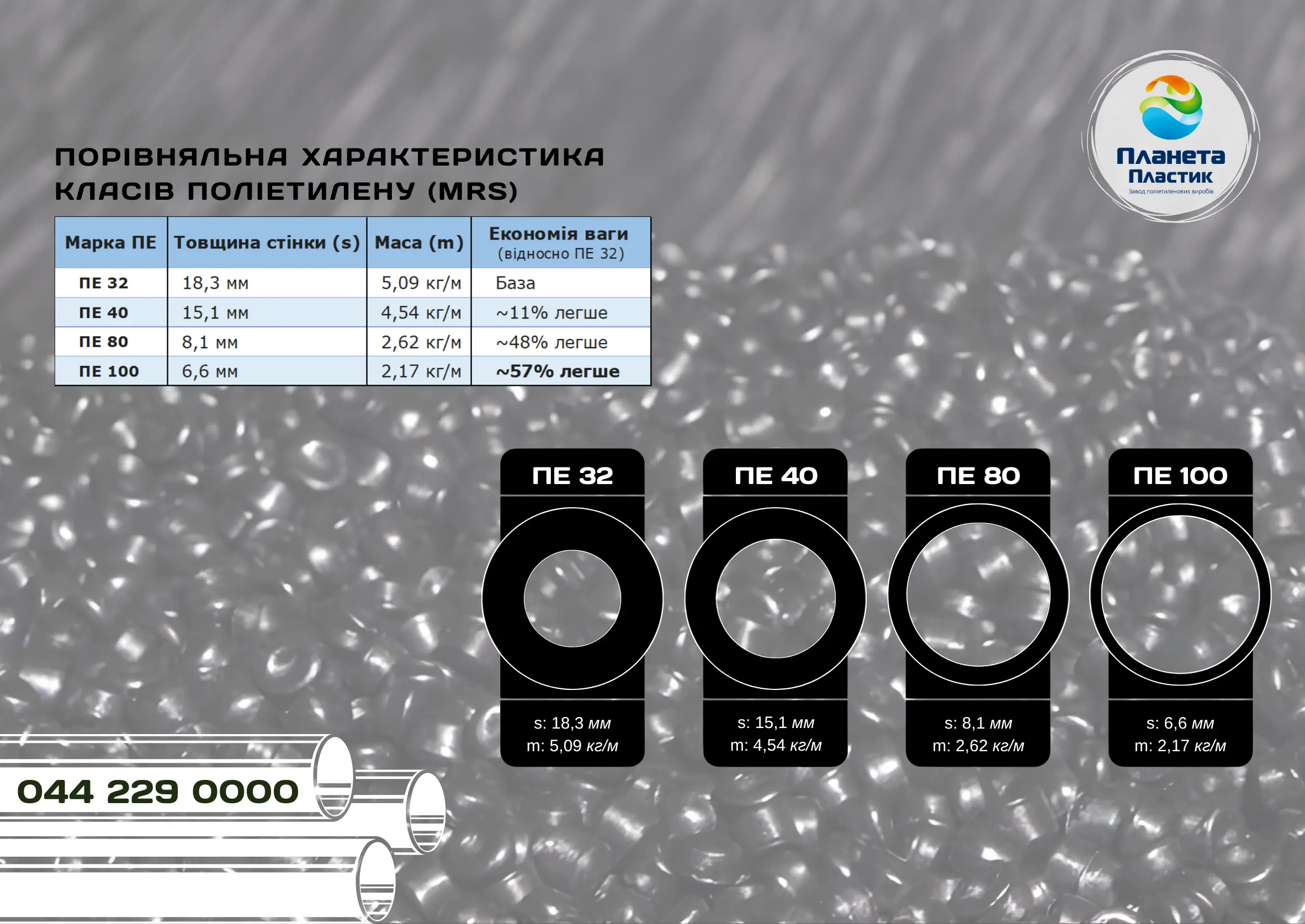
The key indicator for HDPE is MRS (Minimum Required Strength). This determines the grade of polyethylene used to make the pipe: PE80 or PE100. The higher the number, the stronger the pipe under long-term load.
But how can you verify durability without waiting 100 years?
Pipes are tested under extreme conditions – elevated pressure and high temperatures – to calculate their real resource. These calculations are confirmed by real – world operation. According to the PE100+ Association, the calculated service life for PE100 pipes is 100+ years.
British UKWIR studies confirm: HDPE pipes laid in the 1950s are still in active service today without critical wear.
These are facts. But between facts and material trust, there is often something else – beliefs passed down from neighbor to neighbor or contractor to client, living a life of their own.
These baseless beliefs are often what dictate pipe choice. Let’s look at them individually.
Myths and Reality
Myth 1: “Plastic is weak, metal is reliable.”
When people hear “polyethylene,” they often think of a supermarket bag or a water bottle. Naturally, a pipe made of that material wouldn’t inspire much confidence.
But a PE pipe is not that kind of polyethylene. It is made of PE100 – high-density polyethylene, a material with a fundamentally different molecular structure and entirely different characteristics. A bag and a pipe share a name, but it’s like comparing a paper cup to an oak plank. Both come from wood, but the similarity ends there.
PE100 withstands working pressure up to 16 bar. It does not rust. It does not react to chemical compounds in soil and water, and it flexes – but doesn’t crack – under temperature fluctuations. The American Water Works Association (AWWA) calls it the material of choice for underground pipelines – not as a budget alternative, but as the optimal engineering solution.
Metal is certainly strong, but instantaneous tensile strength and long – term durability in real conditions are two different things. A steel or cast – iron pipe in an aggressive soil environment requires, at minimum, protective coating, anti-corrosion treatment, and regular monitoring. PE100 in the same conditions requires none of this – corrosion simply does not exist for it. That is why, in the long run, “unreliable plastic” often proves to be a more practical choice than “reliable metal.”
Myth 2: “Where did these 100 years come from – is it just a marketing number or is there proof?”
There is proof – and the most convincing evidence isn’t found in a laboratory.
The first industrial HDPE pipelines appeared in Western Europe in the late 1950s. It is now 2026—they are over 75 years old and still in operation. The British organization UKWIR, which systematically researches the state of water infrastructure, studied these pipelines and recorded no critical material wear.
These are first – generation pipes made of PE80 using the technology of that era. Since then, materials and extruders have significantly evolved: denser molecular structures, more precise raw material control, and stricter manufacturing standards. The PE100+ Association – an international organization of independent industry researchers – determines a minimum calculated resource of 100 years for modern PE100 pipes based on standardized testing. The AWWA confirms these findings in its technical standards.
One hundred years for modern PE100 is a conservative forecast. It is based not only on lab experiments but on what has already happened to the previous generation of the material.
Myth 3: “Plastic crumbles under the sun and frost.”
This myth has a factual basis – but not regarding PE pipes.
Ordinary polyethylene without stabilizers does indeed handle UV poorly: it yellows, becomes brittle, and cracks. This is why most people who have seen plastic disintegrate in the sun automatically apply that experience to PE pipes. But there is a crucial detail visible to the naked eye.
PE pipes are black. This is not by chance.
Carbon black is added to HDPE during production – it absorbs ultraviolet radiation and protects the molecular structure from breakdown. This is what gives the pipe its black color. Without this protection, a pipe in the open sun would degrade in a few seasons. With it, it works for decades, even when laid above ground.
Frost is a different story. Many materials become brittle in extreme cold: one hit and they shatter. This doesn’t happen with PE100 because it has an extremely low brittleness temperature – around -70°C. In the Ukrainian climate, the pipe remains practically as flexible as it is in summer. It can be transported and bent in the frost without risk of damage. The only caveat: welding during installation is still recommended at temperatures above freezing – this is a requirement for the joining technology, not the material itself.
Myth 4: “PE pipes won’t withstand the pressure of heavy – duty systems.”
This misunderstanding arises because PE pipes come in many varieties. They look similar on the outside but have very different specs. Someone who has only handled a garden irrigation pipe might logically doubt if the same material is suitable for a serious pressurized system.
But “the same” is only a surface-level observation.
Every PE pipe has a PN rating—the nominal pressure it withstands under working conditions. PN6 is for irrigation and gravity systems. PN10 is for standard water networks. PN16 withstands 16 bar, which is more than double the pressure in most municipal water systems. PE100 SDR11 pipes are used in gas supply—an industry with some of the highest safety requirements in construction.
So the question isn’t whether a PE pipe can handle the pressure. The question is whether the correct pipe was chosen for the specific task. It’s like footwear: sneakers and mountaineering boots might look similar, but they are entirely different tools for different conditions.
Myth 5: “PE pipelines leak.”
PE pipes are joined in two ways. The first is welding: butt fusion or electrofusion. A properly executed weld is as strong as the pipe itself. The second is compression fittings: convenient for installation and reliable when correctly matched to the diameter and working pressure.
Both methods work. However, the result depends entirely on who installs it and how. Welding requires proper equipment and experience. Fittings require the correct selection of characteristics for the specific system. When these are missing, leaks occur. This is an installation issue, not a material flaw.
Therefore, before starting work, spend time not only choosing the pipe but also choosing a contractor with specific experience in PE pipes and the right equipment.
Myth 6: “All pipes are the same – the cheap ones and the expensive ones.”
On the outside, they look identical. Both are black, both are flexible, and both are called PE pipes. The difference is on the inside, and it is practically impossible to see. This is where you must ask for documentation and certificates of conformity.
Quality PE pipe is made from virgin HDPE with a strictly controlled MRS index. In practice, this means the material behaves predictably under pressure, in various temperatures, and over decades of use. A cheaper alternative might contain recycled materials or lower – density polymers – you won’t see it, but you’ll experience it later, likely when you least want to.
The marking on the pipe is the first guide: PE100, SDR, PN, manufacturer’s name, and date of production. But markings are just text. Real proof of quality lies in certificates of conformity and technical documentation for each batch from the manufacturer. A reliable manufacturer provides these without hesitation.
What Actually Shortens Service Life
If the material is high quality and the pipe is installed correctly, it will work for decades without your intervention. However, a few factors can significantly shorten its life – and all of them are in human hands, not the material’s properties.
⨂ Exceeding Working Pressure
Every pipe is rated for a specific maximum pressure indicated in its marking. Systematically exceeding this doesn’t destroy the pipe instantly, but it gradually accumulates material fatigue. It’s like bending a metal paperclip: once is fine, but a hundred times in the same spot, and it breaks. Therefore, don’t just buy “any PE pipe” – choose the correct PN for the real pressure of the system.
⨂ Poor Quality Installation
The most vulnerable spot in any pipeline is the connection. Improperly performed welding, mismatched fittings, or violations of laying technology create stress concentration points. A pipe can work for years without issues and then fail exactly where the installation was botched.
⨂ Mechanical Damage During Laying
PE100 is strong but not invulnerable. Sharp rocks in the trench, improper bedding, or heavy machinery driving over an uncovered pipe all create local damage. This might not be visible from the outside but impacts longevity. Proper trench preparation and maintaining the correct laying depth isn’t a bureaucratic requirement – it’s real protection for the pipe.
⨂ Incompatible Environment
PE100 is chemically inert to most substances—but not all. Concentrated organic solvents and certain petroleum products can affect the material during prolonged contact. If the system will work with non-standard fluids, check chemical compatibility with the manufacturer’s technologists beforehand.
⨂ Low-Quality Raw Materials
This was mentioned in the myths section but bears repeating. Pipe made from recycled or low – grade raw materials can have unpredictable characteristics even under proper installation and normal pressure. Material documents are not a formality; they are insurance.
Most of these factors are determined before the pipe even hits the ground. The simplest way to protect yourself is to choose the right PE pipe from the start.
How to Check PE Pipe Quality During Purchase
Once a pipe is in the ground, checking it becomes impossible. That’s why a few minutes of attention during purchase are worth much more than a dug-up yard a year later.
✓ Step 1: Inspect the Pipe
Take the pipe and look at the cross-section (the end). The wall should be uniform all around—no thickening, depressions, or visible inclusions. Then, find the markings on the surface: PE100, SDR, PN, diameter, manufacturer name, and date. They should be clear and indelible. The marking tells you exactly what you’re getting and what it’s built for.
✓ Step 2: Ask the Seller
Two simple questions: is the pipe made from virgin or recycled raw materials? And are there documents? The answers will immediately tell you what kind of PE pipe you are dealing with.
✓ Step 3: Check the Documents
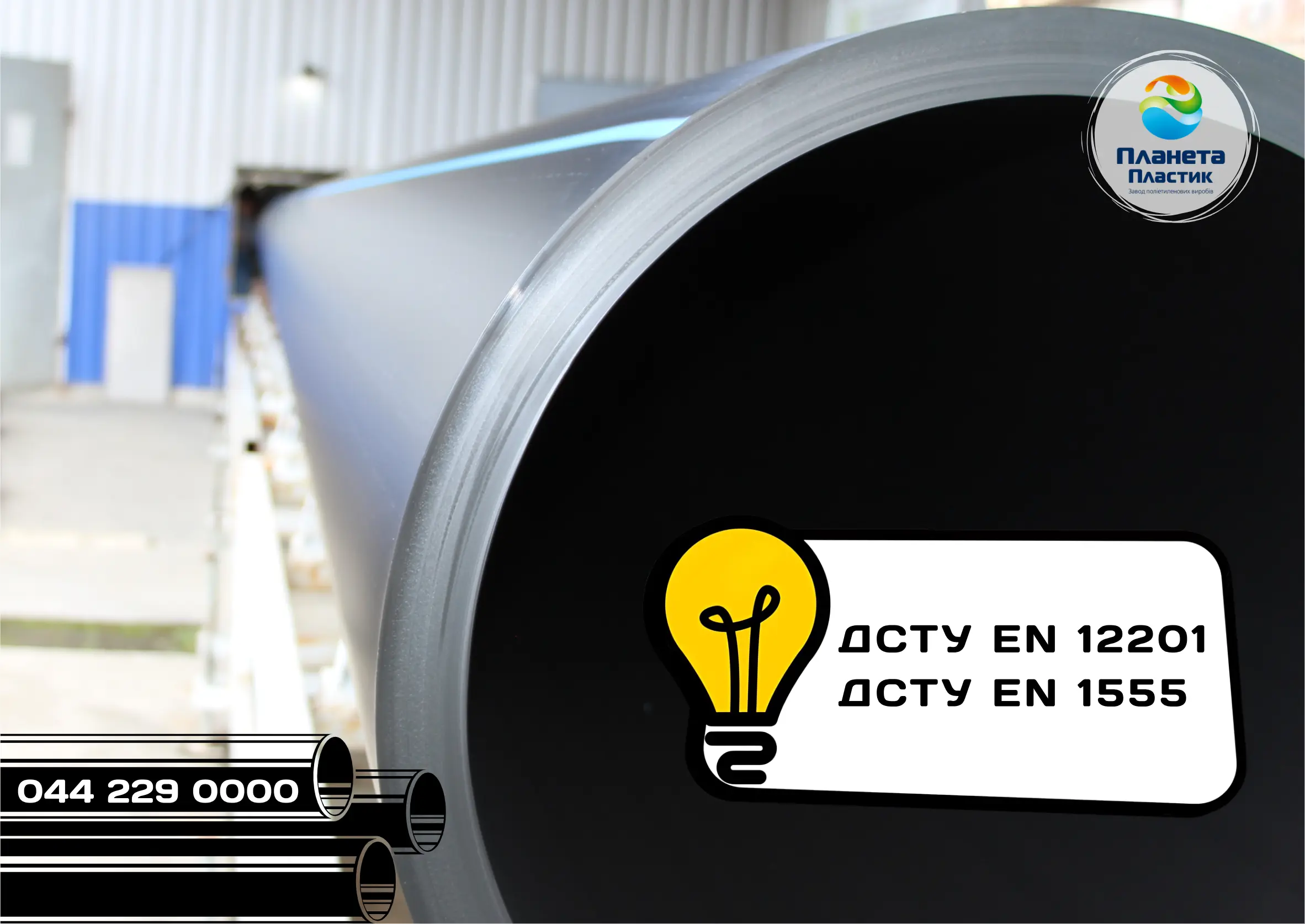
In Ukraine, all PE pipes are certified according to DSTU EN 12201 (water) or DSTU EN 1555 (gas). Quality documents must be for the specific batch and have a current date. A responsible manufacturer provides these without being asked twice.
Just three steps during purchase—and a dug-up yard a year later will remain just a “scary story” from a neighbor who didn’t know how to check pipe quality.
We’ve gone from molecular HDPE structures to the documents you should demand from a supplier. If you take one thought away from this article, let it be this: the service life of a polyethylene pipe isn’t a matter of luck. It is the result of specific decisions: what material, which manufacturer, and how it was installed.
Make the right decisions at the start, and the pipe just works. For decades. Without your involvement.
If you have questions or need help choosing, the Planeta Plast factory produces PE pipes from virgin PE100 in Irpin and provides consultations at every stage: from selecting diameter and pipe type to installation recommendations.