Greenhouse film specifications. Choosing between “Greens”, ST or UV
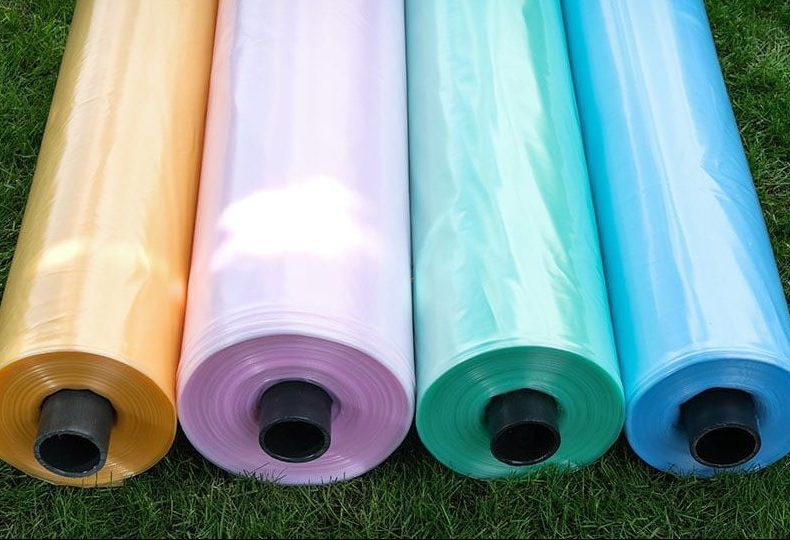
The primary function of any greenhouse film is to protect plants from atmospheric phenomena (sun, rain, hail, snow, wind, etc.). Why is this necessary? To extend the vegetative period of plants and create a controlled microclimate inside, regardless of the weather conditions outside.
Greenhouse Films Come in Two Main Types:
- Stabilized. Engineered for a long service life—12 months or more. This is achieved by adding a special substance—a light stabilizer—which protects the film structure from the destructive effects of UV rays.
- Unstabilized. Can serve on a greenhouse for no more than 6 months due to the lack of UV protection.
Almost all greenhouse films of our manufacture are stabilized. Our range of stabilized greenhouse films includes the Greens film, as well as the ST series and the UV series.
“Greens” Greenhouse Film
This is a single-layer stabilized greenhouse film with a service life of up to 12 months and a width of 6 meters. It is an ideal product for a small, budget-friendly greenhouse or cold frame. The film thickness is available in 100, 120, and 150 µm. Color: green.
Greenhouse film with a thickness of 100 µm is used to cover greenhouses for the spring-summer season; it is recommended to remove such film for the winter. Greenhouse film with a thickness of 120 or 150 µm can be used for greenhouse covering during the winter season or in wind-prone regions.
“Greens” is the only greenhouse film we manufacture using a combination of virgin and secondary (recycled) polyethylene. By incorporating recycled raw materials into its composition, we have succeeded in creating an inexpensive and environmentally friendly product through the processing of used polyethylene. Our plant operates two powerful lines for recycling used polyethylene. We reprocess all of our own polyethylene waste and also purchase third-party scrap. This is one of the principles of the circular economy that we follow. The rest of our greenhouse films are manufactured strictly from virgin raw resins.
ST 24 Greenhouse Film
This is a single-layer stabilized greenhouse film with a service life of up to 24 months and a width ranging from 2 to 6 meters. The film thickness ranges from 80 to 150 µm. Color: yellow.
Note: Greenhouse film with a thickness of 80 µm is typically utilized as an internal layer within the greenhouse (a “second ceiling”).
ST 36 Greenhouse Film
This is a single-layer stabilized greenhouse film with a service life of up to 36 months and a width of 6 meters. The film thickness is 150 µm. Color: pink.
UV Series Greenhouse Films
These are multi-layer stabilized greenhouse films featuring enhanced mechanical strength, designed specifically for the construction of large industrial greenhouse complexes.
How Multi-Layer Films Differ from Single-Layer Alternatives
Multi-layer polyethylene film for greenhouses is manufactured using the method of co-extrusion, combining several layers containing distinct polymers and additives. This means that during production, specific components can be added to each individual layer of the film to impart targeted properties. As a result, each layer provides unique performance characteristics to the film, maximizing its efficiency through successful synergy with the other layers. Consequently, our multi-layer UV series films are 30% more resistant to tearing and 50% more resistant to punctures than single-layer films, even with a lower thickness and correspondingly lower weight.
Within the UV series greenhouse film range, we offer 4 varieties with varying service lives and thicknesses:
- UV2 Greenhouse Film — a multi-layer stabilized greenhouse film with a service life of 12 months and a width from 8 to 12 meters. Film thickness is 100 µm. Color: yellow.
- UV4 Greenhouse Film — a multi-layer stabilized greenhouse film with a service life of 24 months and a width from 8 to 12 meters. Film thickness is 120 µm. Color: green.
- UV6 Greenhouse Film — a multi-layer stabilized greenhouse film with a service life of 36 months and a width from 8 to 12 meters. Film thickness is 150 µm. Color: pink.
- UV10 Greenhouse Film — a multi-layer stabilized greenhouse film with a service life of 60 months and a width of 12 meters. Film thickness is 180 µm. Color: blue.
Does the Color of a Greenhouse Film Affect Its Quality or Crop Yield?
The variety of colors in our greenhouse films is primarily intended for consumer convenience, allowing users to easily distinguish how many seasons a film is designed to last based on its color indicator. Therefore, when choosing our film in a store, the consumer can determine by color that a yellow UV film is guaranteed to last 2 seasons (12 months), a green UV film for 4 seasons, a pink UV film for 6 seasons, and a blue UV film for 10 seasons (5 years). At the same time, the color of the film—or more precisely, the color pigment and film thickness—in no way affects the transparency of the film or its light transmission and diffusion properties.
High light transmission is absolutely essential for plant growth. Our manufacturing experience, equipment quality, and careful material selection guarantee that our films feature maximum light transmission capabilities. Our greenhouse films possess a light transmission rate of no less than 90% of PAR light (Photosynthetically Active Radiation).
Over time, of course, any greenhouse film partially loses its light transmission capabilities. This is where the quality of the film and the raw materials used by the manufacturer become vital, because a high-quality greenhouse film loses only up to 2% of its light transmission capacity per year. Therefore, regardless of our film’s color, solar energy is transmitted equally through the greenhouse covering to the plants, driving the process of photosynthesis.

Recently, our range of multi-layer greenhouse films has been expanded with XL films—these are wide-format films designed for building large industrial greenhouse complexes.
UV6 XL Greenhouse Film
This is a multi-layer stabilized greenhouse film with a service life of 36 months and a width of 14 and 16 meters. The film thickness is 150 µm. Color: transparent.
We hope that this article has helped you understand the primary varieties of greenhouse film and their characteristics, thereby simplifying the task of choosing the right greenhouse covering. For those who are just planning to build a structure, our article on how to build a small, budget-friendly film greenhouse on your own will be highly useful.
Wishing everyone a rich harvest!