How to successfully use grain sleeve storage technology

The core principle of polymer bag storage technology relies on the hermetic storage of dry grain and animal feed within an artificially controlled environment. This setup features a low oxygen level and a high concentration of carbon dioxide (CO2), achieved through the natural self-conservation process of the grain during the first 2 weeks of storage. Utilizing grain storage sleeves provides a range of benefits over conventional grain storage methods, notably in terms of logistics and finance. It also allows you to sort grain by type and store it until market conditions become highly favorable for sale.
Get a free sample of the Harwell™ grain sleeve
Operating Rules for Grain (Silage) Sleeves
These recommendations must be followed not only when selecting a grain storage sleeve but also during its operation to preserve the quality of the grain over a long period:
- Grain is a living organism, so it must be healthy, clean, and free from mechanical damage.
- The moisture content of the stored grain must not exceed the recommended values.
- Crop storage risks associated with grain moisture level:
- Low (wheat, soy, corn – up to 14%, sunflower – up to 11%)
- Medium (wheat, soy, corn – 14-16%, sunflower – 11-14%)
- High (wheat, soy, corn – over 16%, sunflower – over 14%)
- Try to avoid getting plant protection products or other chemical substances on the sleeve.
- The use of aggressive substances to remove contaminants from the surface of the sleeve is strictly prohibited.
- It is strictly forbidden to burn anything near a filled sleeve.
- Walking on a filled sleeve is prohibited!
Site Selection and Surface Preparation
- Loading grain into a polymer sleeve must take place on a firm, clean, and dry surface, away from flammable objects.
- If the chosen surface has a slope, the sleeves should be positioned along the incline. Avoid placing sleeves in lowlands, waterlogged areas, or sites with high groundwater levels.
- Prior to loading, the site surface must be prepared for placing the sleeves: clear and clean the area of stubble, gravel, crushed stone, rocks, and any other foreign objects with sharp, cutting, or piercing edges to prevent damage to the sleeves during loading and throughout the storage period.
- There should be no spilled grain on the site or around the sleeve. This can attract rodents and birds that might damage the bag.
ATTENTION! Inadequate site preparation can cause cuts or punctures in the lower section of the sleeve, leading to a loss of hermetic sealing and an increase in the moisture content of the stored grain.
Unpacking the Grain Sleeve Box
- Position the box containing the grain sleeve facing toward the bagger, following the direction indicated by the arrow pointer on the top of the box.
- Remove the packaging wrap and strapping bands from the grain sleeve box. Open the box.
ATTENTION! The binding straps on the grain sleeve are not designed for lifting the sleeve out of the box.
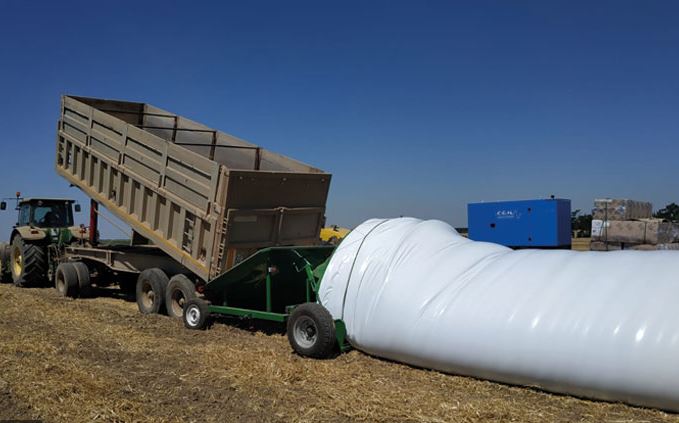
Filling
- Place the sleeve on the ground near the bagger without unfolding it. There is an arrow pointer on the sleeve that must align with the center of the bagger and point toward the loading tunnel. Check the entire surface of the loading tunnel to ensure it is free of foreign objects and sharp protrusions to avoid damaging the sleeve during loading.
- Specialized equipment is required for storing grain in bags. Use the bagger mechanism to lift and fit the sleeve onto the tunnel pipe. It is vital to mount the sleeve correctly (it must be positioned at the edge of the tunnel pipe).
- Remember that the lines indicating the stretch level must remain visible along the sides of the sleeve.
- Remove the protective bands. Secure the sleeve using the elastic cords located on the bagger, and unfold the edge by 2.5 m.
- Once the sleeve is secured on the bagger, tie the unfolded edge with the cord included in the packaging kit and place the knot underneath the bagger; this ensures that during loading, the edge of the sleeve will be tightly pressed down by the weight of the grain.
- After loading starts, monitor the filling accuracy of the sleeve and, if necessary, adjust the bagger loading process using the machine’s braking system. The surface of the filled portion of the sleeve must be flat and smooth.
- Two parallel lines printed along the entire length on the sides of the sleeve serve as a stretch indicator during loading. The distance between the stripes on an unfilled sleeve is 40 cm. During the loading process, monitor the degree of sleeve stretch by measuring the distance between the lines with the ruler provided in the kit. The stretch must not exceed 10% (no more than 44 cm between the lines)!
- Seal the end of the loaded sleeve tightly with a rope or clamp it using wooden slats. To prevent damage to the sleeve by rodents, cover this end with soil. Mark the moisture percentage of the product, the loading date, and the grain type on the surface of the loaded sleeve (this information is applied using spray paint or markers).
- If the sleeve is damaged or punctured during storage, promptly seal the tear or puncture site with tape to restore and maintain the hermetic environment inside.
Important:
- If the site surface is wet and slippery, ensure the sleeve fills evenly and the loading machine moves smoothly without jerking, adjusting the braking mechanism as needed.
- To accurately measure the dimensions of the grain storage sleeves and their stretch during loading, the parallel lines must be at a height of at least 1 m above the ground surface.
- Stop loading immediately if the distance between the marking lines reaches the red “STOP” mark on the ruler.
- Upon completing the loading process, there must be no spilled grain on the site or around the loaded sleeves. Any grain spilled during the loading process must be thoroughly cleaned up to avoid attracting rodents and birds that could damage the sleeve during storage.
What temperature is optimal for grain storage? Before puncturing the sleeve to measure the grain temperature (which should not drop below 10°C) or taking a sample for testing, pre-tape the puncture site crosswise with adhesive tape. After sampling, seal the hole lengthwise with tape.

Unloading the Sleeve
- If you use a protective cover for the sleeve and its color is not white, remove it one day prior to unloading to equalize the temperature.
- Please note: unloading the sleeve must begin from the end where the loading process finished.
- The knife of the unloading machine must be sharp along the entire length of its cutting edge.
- Before starting the discharge process, open the end of the sleeve and secure it onto the specialized roller of the unloading machine.
- Do not drive the unloading machine knife into tightly stretched film. This can cause the sleeve to tear.
- The knife must be positioned perpendicular to the sleeve and cut in a straight line at the highest point directly along the longitudinal axis of the sleeve, without drifting right or left.
- During unloading, monitor the travel speed of the unloading machine, the grain extraction rate from the sleeve, and the winding speed of the emptied sleeve onto the specialized roller.
- If pauses occur during grain discharge from the sleeve, ensure the sleeve is not under excessive tension on the unit – this minimizes the risk of a tear.
ATTENTION! Never make longitudinal cuts on the top or along the sides of the sleeve. These can trigger a rip down the entire length of the bag. An improperly positioned knife can cause the sleeve to burst. Insufficient grain extraction speed combined with a faster winding speed than necessary onto the roller can cause the sleeve to tear due to excessive tension.
How Much Does Wheat Grain Storage Cost
If you are interested in the storage cost per ton of grain, you can review the prices for our loading and unloading services, or the necessary machinery, in the relevant sections of our website. To calculate the efficiency of this storage method compared to traditional grain elevators, we recommend using our specialized online calculator.
Thus, a correctly calculated storage strategy and adherence to straightforward operating rules will allow you to gain maximum profit from your harvest sales. Harwell™ grain sleeves are the technology behind your profit.
Wishing everyone a rich harvest!