About storing silage in sleeves
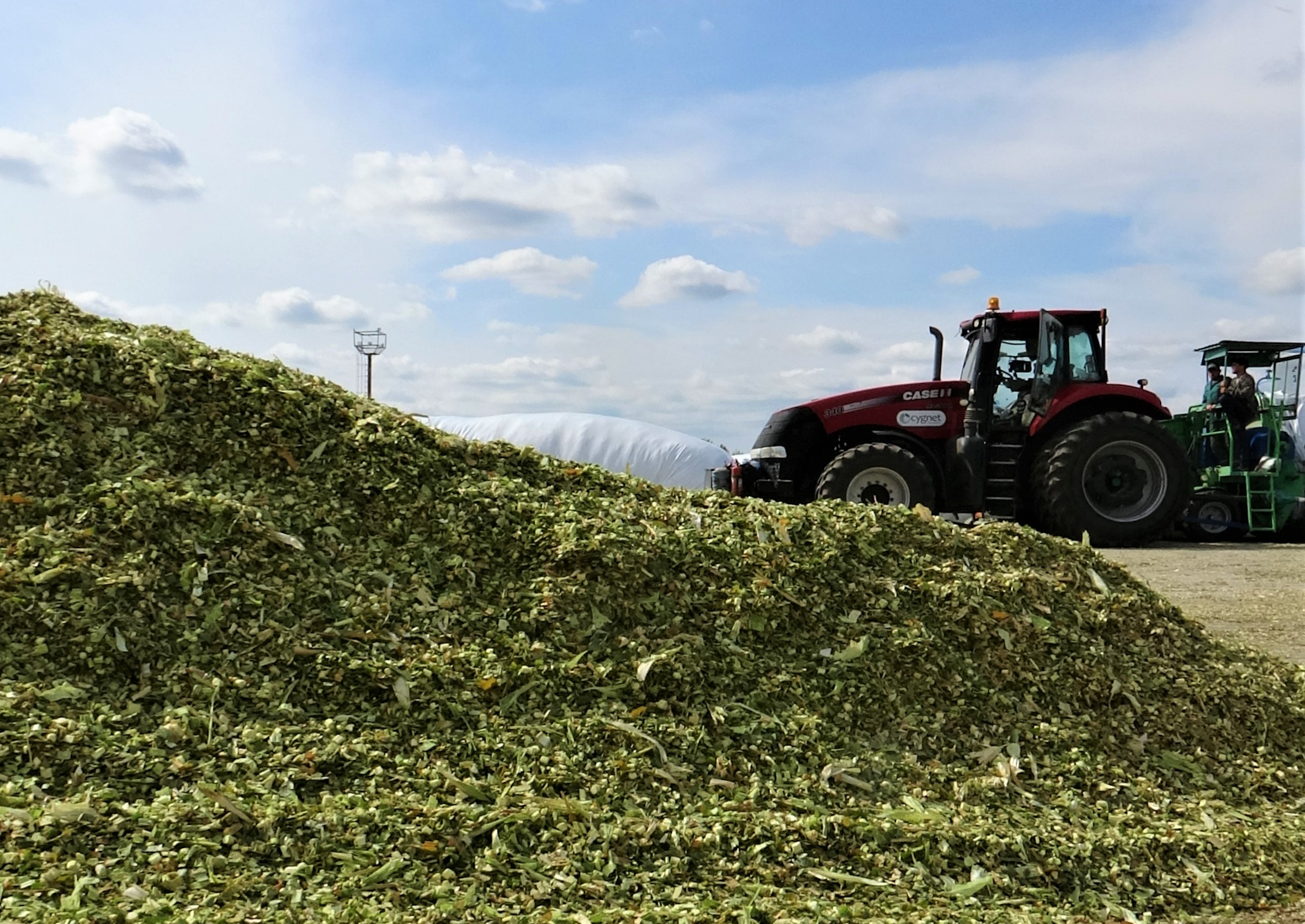
“For 10 years, we have been packing two types of forage—corn silage at 10,000 tons and alfalfa haylage at 2,500 tons. We begin packing into sleeves in May during the first cutting of alfalfa. The second cutting takes place in June, and the third in July. Then, in late August or early September, we pack the silage,” says Serhii Stepanydenko, CEO of “Cygnet-Milk”.
Packing Silage: Technology and Basic Metrics
Practically all types of forage can be stored in sleeves: silage, haylage, cornage, beet pulp, brewer’s grains, distillers grains, and others. The primary advantage of storing in sleeves is the superior quality of ensiling of the packed mass and forage.
The forage harvesting technology at “Cygnet-Milk” operates as follows. Pre-chopped forage mass is hauled to the silage press. Next, the mass is delivered onto the feed table of the press, either directly from a dump truck or by means of a front-end loader. The feed table conveyor feeds the mass to the rotor, which pushes it into the sleeve. During this process, the mass is compacted (at a pressure of 400–500 bar), and air access to it is completely cut off.
“We determine moisture content using a microwave and check the chopping length with a ruler. The moisture content of the haylage we pack is 55–60%, with a chopping length of up to 3 cm. Silage is packed at a moisture content of 62–68%, with a chopping length of up to 1.5 cm,” shares Serhii Stepanydenko.
Thus, when packing silage and haylage into polymer sleeves, special attention must be paid to the moisture content and the chopping length of the mass.
Quality: What is More Efficient—a Silage Pit or a Sleeve?
- Instant closure of the compacted mass (weather conditions have virtually no impact: if it starts raining, the sleeve is sealed, whereas dealing with a pit is more complicated);
- Minimization of undesirable reactions during the preservation process, as well as nutrient losses during storage (rapid exclusion of air access prevents the proliferation of putrefactive bacteria, and the preservation process of the mass occurs significantly faster);
- No introduction of ash into the feed by machinery wheels (in a pit, ash can be introduced by the wheels of tractors compacting the silage. In sleeves, this is completely eliminated since the mass goes directly onto the conveyor of the silage press);
- Minimization of nutrient losses during feeding (in a sleeve, when we extract silage or haylage, only a small surface area is exposed, from which fewer nutrients volatilize—2 meters high and 3 meters wide—and this area remains covered. In a silage pit, this is practically impossible to achieve unless you purchase an additional specialized silage defacer or bucket for extraction).
Furthermore, storing silage in a sleeve means there are no “frozen capital investments”.
Based on materials from Latifundist.com