Bacterial cancer of tomatoes: why does it occur and how to fight it?
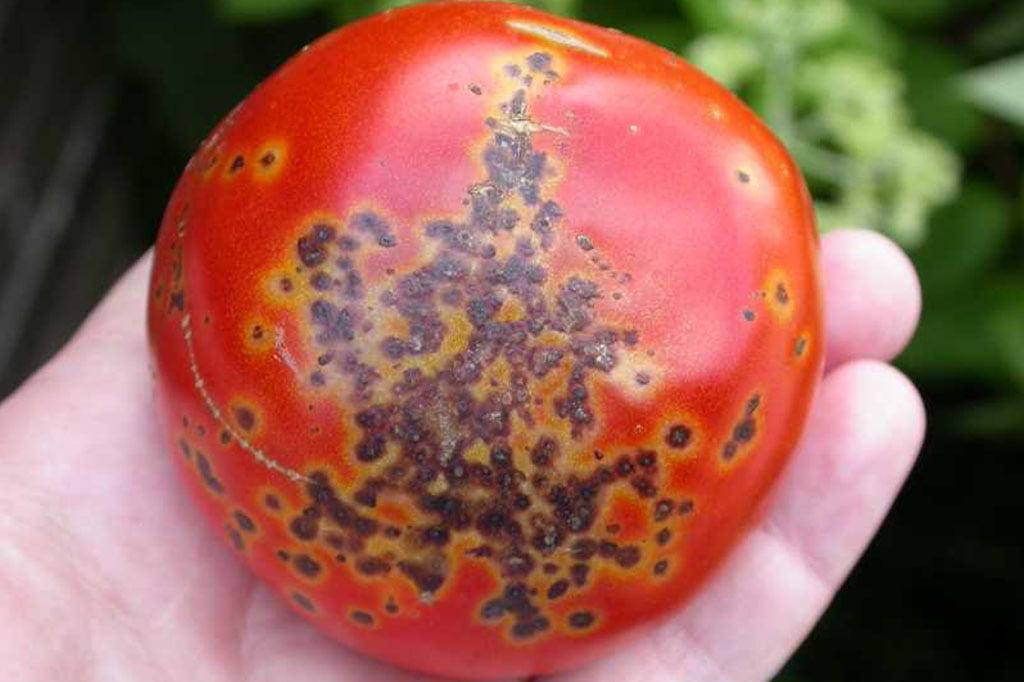
Bacterial canker of tomato causes massive plant mortality. The first sign of disease infestation is wilting leaves. Moreover, wilting may be observed only on one side of the plant. The edge of the leaflet turns yellow. Wilted leaves curl upward and inward, and later turn brown and wither, but do not drop off. Such damage is typical for tall varieties / hybrids in greenhouse conditions. A typical sign of bacterial canker is the so-called “bird’s eye”. Small, light spots appear on green fruits.
Combating Bacterial Canker of Tomatoes in Greenhouses

The causative agent of bacterial canker of tomatoes is the bacterium Clavibacter michiganensis subsp. michiganensis, which infects only plants from the Solanaceae family. It is an aerobic, Gram-positive, non-motile, capsule-forming rod. The most favorable conditions for the development of bacteriosis are temperatures from +20°C to +28°C and a relative air humidity of 80–85%. The causative agent of bacterial canker of tomatoes does not tolerate an acidic environment. At a pH of 4.0–4.5, the bacteria die within 24 hours. These bacteria can persist in air-dry soil and in plant debris for up to 8 months. They easily withstand the drying and freezing of the soil.
For open ground, the salvation from infection lies in crop rotation, destruction of Solanaceae plant debris, and the use of healthy seeds. If the disease does manifest itself, it is easier to remove the infected plants than to attempt treatment. In greenhouses, bacteria persist in the substrate, on structural parts of the greenhouse, tools, and equipment. It is recommended to sanitize (sterilize, fumigate) the substrate and disinfect all internal surfaces.
Source of Infection and Contamination Conditions
The source of primary infection for bacterial canker of tomato is infected seeds. It was with them that the pathogen was first introduced to the territory of the former USSR back in 1936. In greenhouses, the main source of infection is the greenhouse itself: structures, coverings, and stationary equipment that have accumulated the infection over the years of tomato cultivation preceding a high-quality disinfection.
The number of bacteria on the plant surface during the growing season is not always constant: it changes depending on the season, weather, and the age of the plant. As the plant grows, the number of bacteria on it increases. And the higher the temperature and humidity, the faster the bacteria develop and spread. The transfer of infection is carried out mechanically from a diseased plant to a healthy one. Most often, the infection is carried out by workers who are in direct contact with the plants. Bacteria spread through clothing, tools, and hands. The pathogen enters the plant through mechanically damaged tissues: injured roots, stems, and leaves. This happens during suckering, when cutting leaves, or when harvesting fruits. Contamination occurs very rapidly through the root system if the integrity of the root hairs is compromised. Under high air humidity in dense plantings, bacteria are able to penetrate neighboring plants through the hairs on the leaves.
Two Forms of the Disease
There are two distinct forms of manifestation of bacterial canker of tomato: systemic (diffuse) and localized. The systemic form is observed in plants that have grown from infected seeds or were infected during the growing season. In systemic damage by bacterial canker, the infection spreads through the vascular system, destroying and clogging the vessels. The affected plant wilts from the bottom up. Darkening of the affected vessels can be detected on cross-sections of the stem and the petiole of a diseased leaf. Dark streaks appear on drying stems. The roots of such a plant look fresh and healthy. Numerous warts often form near the base of the stem. The fruits exhibit one-sided development, dark liquid pulp, and grey-colored seeds.

The localized (local) form of the disease is the result of secondary spread of bacteria that do not reach the plant’s vessels. The localized form manifests as spots on fruits and leaves, as well as cankers on pedicels, shoots, petioles, and veins.
Control and Prevention of Tomato Bacterial Canker
The primary importance in combating bacterial canker of tomatoes is the early detection of infection. If bacterial canker manifests in a localized form, treatment with a bactericide can halt the spread of the infection. The diseased plant will stand a chance to survive and form a harvest. The most common chemical bactericides are preparations of various copper compounds (copper hydroxide, copper oxychloride, copper sulfate) and ethylene bisdithiocarbamates (mancozeb).

If signs of infection are detected in the systemic form, when the pathogen has taken over the vessels of the stem, we ruthlessly remove the diseased plant. This is simpler and more rational: a terminally ill plant cannot survive, while its neighbors, saved from the source of infection, can avoid contamination.
Seed Disinfection
We act proactively by disinfecting the seeds. The causative agent of tomato bacterial canker does not tolerate high temperatures and low pH levels. Thermal (heating) and chemical (soaking in a weak acid solution) disinfection methods are used. However, bacteria can reside inside the seeds, including within the embryo. Therefore, ridding the seed material of the infection while maintaining a high germination rate is not easy. Too little “heat” and the pathogen survives; too much and the seed embryo dies.
Heating:
- Wet method: soak seeds for 20 minutes in water heated to a temperature of +48°C to +50°C. The temperature must be maintained strictly within the specified limits, as at temperatures above +50°C the seeds lose their germination function, and below +48°C it is ineffective against the bacteria. After heating, the seeds are quickly cooled in cold boiled water for 2–4 minutes, spread out in a thin layer, and dried in the air (not in the sun) until free-flowing.
- Dry method: seeds are heated at a temperature of +53°C for 30 minutes.
Soaking:
- Treating seeds with a 20% hydrochloric acid solution for 5–10 minutes rids the seeds of external infection. Alternatively, soaking in a 0.8% acetic acid solution for 24 hours can be used.
- Treating seeds with an alcohol or aqueous solution of dried immortelle inflorescences. For pre-sowing preparation, seeds are soaked in a 9% aqueous or 5.25% alcohol solution for 2.5 hours, after which they are dried to a free-flowing state and used for sowing no earlier than 10–15 days later. Such treatment is effective for preventing plant damage by tomato bacterial canker, bacterial black spot, wet rot, blossom end rot, other rots, and viral diseases (mosaic, stolbur).
- Soaking seeds for 2 hours in a 0.2% working solution of “Phytolavin-300” (Streptomyces lavendulae). This preparation contains the antibiotic phytobacteriomycin. It is also possible to dip the roots of seedlings into this solution and spray the seedlings twice in the phase of 1–3 true leaves with a 0.2% suspension of this product.
Soil Disinfection
Adhering to crop rotation, timely removal of diseased plants, and destruction of plant debris are the most accessible methods for preventing bacterial canker of tomatoes. In greenhouses, no amount of caution is excessive. Therefore, it is advisable to disinfect the substrate in the greenhouse using chemical or thermal methods. For example, steam sterilization can be used to heat the soil covered with film.
Many people use a solution of copper sulfate or formalin to disinfect the soil—this involves pouring a working solution of sulfate (5 g per bucket of water) or formalin (100 ml of 40% solution per bucket of water) into grooves 8–10 cm deep. The application rate of the working solution is: 10 liters of sulfate per 1 sq.m., and 20 liters of formalin per 1 sq.m. After pouring the solution, the grooves are covered with soil, the soil surface is covered with film, and it is kept for three days. Afterwards, the greenhouse is opened for two weeks, and the soil is tilled. In reality, both formalin and copper sulfate are far from the safest substances, and is it worth risking health by using such soil disinfection methods?
In industrial greenhouses, even more toxic substances are used. For example, the fumigant metam sodium (30 liters per 1,000 sq.m), but soil fumigation with such preparations is carried out strictly according to regulations, adhering to standards, terms, and mandatory protective clothing.
There is a safe alternative fumigation method that can be used in greenhouses of any size: biofumigation. Mustard cake or its chopped green mass (1.5–2 kg per sq.m.) buried in the soil under film releases gaseous products similar in action to metam sodium.
Disinfection of the Greenhouse, Tools, and Equipment
On inorganic surfaces, bacteria can maintain viability much longer than in the soil. Therefore, all internal surfaces of the greenhouse should be viewed as a potential source of infection, and disinfection inside the greenhouse should be conducted with a bactericide. A concentrated hydrogen peroxide solution is safe and effective for these purposes. Peroxide smells better than bleach, and its price is lower. Moreover, the decomposition products of peroxide are completely harmless water and oxygen.
It is particularly important to disinfect the tools used for canopy management operations on tomato plants, especially grafting blades. Without disinfection, one might “cut” 3–5 plants, so the blade should then be disinfected with the same 3% hydrogen peroxide solution or alcohol. To limit secondary infection before scheduled suckering, it is necessary to remove diseased plants. The removal of leaves and suckers should be carried out using a special tool that is regularly disinfected, rather than breaking them off by hand.
The best fight against bacterial canker of tomatoes is the prevention of the disease. Therefore, we maintain cleanliness “cubed”: clean seeds multiplied by clean soil multiplied by a clean greenhouse, tools, and equipment.
Wishing everyone a rich harvest!