How to reduce losses during feed storage. Cost-effective storage methods.

The technology for harvesting and storing forage, such as silage, as well as grain, in polymer sleeves—also referred to as bags or grain sleeves—is gaining popularity in Ukraine.
Harvesting silage and storing it in polymer sleeves successfully resolves the issues faced by farms constrained by warehouse space and storage capacities. You maintain full control over your harvest: store the feed directly on your field, under the open sky, and under your own supervision.
Typically, Ukrainian farmers utilize grain storage sleeves for grain (corn or wheat), although in reality, forage like silage and haylage can also be successfully stored in polymer sleeves.
In the Sygnet agricultural holding, for instance, they began implementing storage technology in grain sleeves back in 2010. They use these sleeves not only for storing corn but also for feed ensiling. For this, they employ Harwell™ grain storage sleeves manufactured by the Planet Plastiс plant.
Notably, harvesting silage and haylage with subsequent storage in polymer sleeves is more economically advantageous than storing them in silage pits or trenches: when storing silage in sleeves, losses amount to only 5% of the total volume, unlike more traditional storage methods in silage pits or trenches where losses reach up to 20%.
The technology of haylage and silage feed production with storage in sleeves protects the feed from the destructive effects of air and ultraviolet rays, guaranteeing its preservation for up to 2 years.
At the Sygnet agricultural holding, we can see a haylage sleeve containing silage and haylage, where the loading into polymer sleeves was carried out back in September of last year, as evidenced by the markings on each sleeve; this year brings a new harvest and a new loading cycle. Alfalfa haylage has already been harvested, and now corn silage is being loaded.
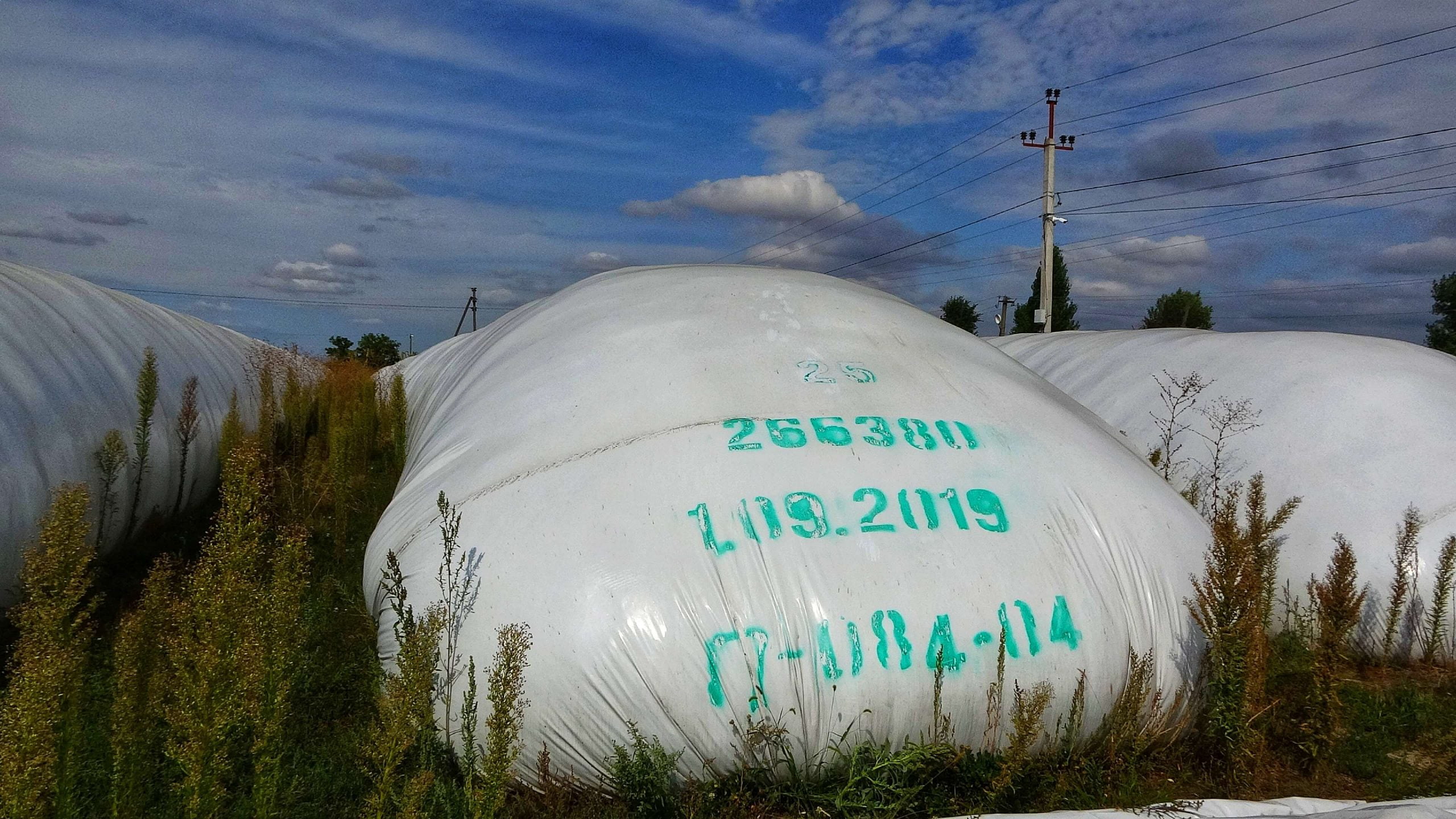
As noted by the Sygnet agricultural holding, storing forage in grain sleeves provides them with a convenient, reliable, and, most importantly, economically profitable method for storing grain, silage, and haylage. To implement this storage technology in polymer sleeves, specialized machinery for storing grain in sleeves is required.
To begin utilizing silage and haylage storage in polymer sleeves, a bagging machine designed for ensiling into sleeves is needed, along with the polymer sleeves themselves.
Harwell™ grain sleeves are manufactured using state-of-the-art extrusion equipment with fully computerized extruders, following a precisely metered, unique formulation. It is this recipe matrix—consisting of 10 different components, including a new-generation polyethylene—that imparts a range of distinctive properties to the Harwell™ grain sleeve:
- High resistance to slumping – the grain sleeve retains its shape after loading, which facilitates easier maintenance and allows it to be operated in the hottest regions of the world.
- High tensile strength and elasticity, high resistance to puncture and tearing, as well as impact strength, which protect against potential damage from hail, animals, or humans.
- Light reflection – prevents overheating of the grain sleeve during the summer. Throughout any season of the year, the grain temperature does not exceed 10°C and does not drop below zero.
- Light opacity – completely eliminates light penetration into the interior, preventing the formation of an environment conducive to the activity of microorganisms.
- Film frost resistance – down to -50°C.
- Resistance to thermal-oxidative and ultraviolet degradation – up to +50°C.
- Service life of Harwell™ grain sleeves – up to 24 months.
Only the most advanced materials, supplied by leading global manufacturers of polymers and additives, are used in the production of Harwell™ grain sleeves. The quality of these grain sleeves is backed by 17 years of experience and the proprietary know-how of Planet Plastiс LLC. Quality control of the finished product is conducted in accordance with international ISO and ASTM methodologies.
The loading process is quite straightforward: the sleeve is secured onto the ensiling bagging machine and its end is tied; a metal gate is also installed (see photo), which holds the edge of the sleeve and is attached to the machine by metal cables. Then, the chopped mass intended for preservation is delivered to the compaction press via tipping silage trailers and discharged directly onto a rubber conveyor belt, which advances the mass toward the packing rotor. The rotor forces the forage through a steel tunnel into the folded sleeve, achieving a regulated compaction of the silage mass. The filled portion of the sleeve is pushed out onto the ground as the machine advances forward. After loading, the sleeve is hermetically sealed, and the metal gate is removed and relocated to load the next sleeve.

The conditions required for ensiling forage in polymer sleeves rely on keeping the haylage or silage within a hermetic environment. The sleeves are impermeable to air, moisture, and solar radiation—thus, the contents of the sleeve are preserved in near-vacuum conditions.
During the natural respiration process of the grain, silage, or haylage—as well as the biological activity of insects and fungi that enter the sleeve along with the crop—oxygen is consumed and replaced by carbon dioxide. This carbon dioxide serves as a natural preservative, inhibiting the vital functions of fungi and microorganisms.
Today, grain sleeves represent a modern and cost-effective solution for storing grain, silage, or haylage. You can order Harwell™ polymer sleeves for storing grain, silage, or haylage from us, along with services for loading and unloading grain from the sleeves.
If you have any questions, please call Oleksandr Chernenko at +38 (050) 388-83-05. He knows everything there is to know about sleeve storage technology.
Wishing everyone a rich harvest!