Storing grain in Harwell™ sleeves is easy

The core of the storage technology in Harwell™ polymer sleeves is the natural preservation of the sleeve contents by creating an anaerobic environment inside a tightly loaded (more than 3 tons per 1 linear meter) and tightly sealed sleeve. Within two weeks from the moment of loading, through the process of grain “respiration” as well as the vital activity of insects and fungi that enter the sleeve along with the grain, oxygen is absorbed and carbon dioxide is produced, acting as a natural preservative. The concentration of carbon dioxide prevents further vital activity of fungi and microorganisms.
What a Harwell™ Polymer Grain Storage Sleeve Realy Is
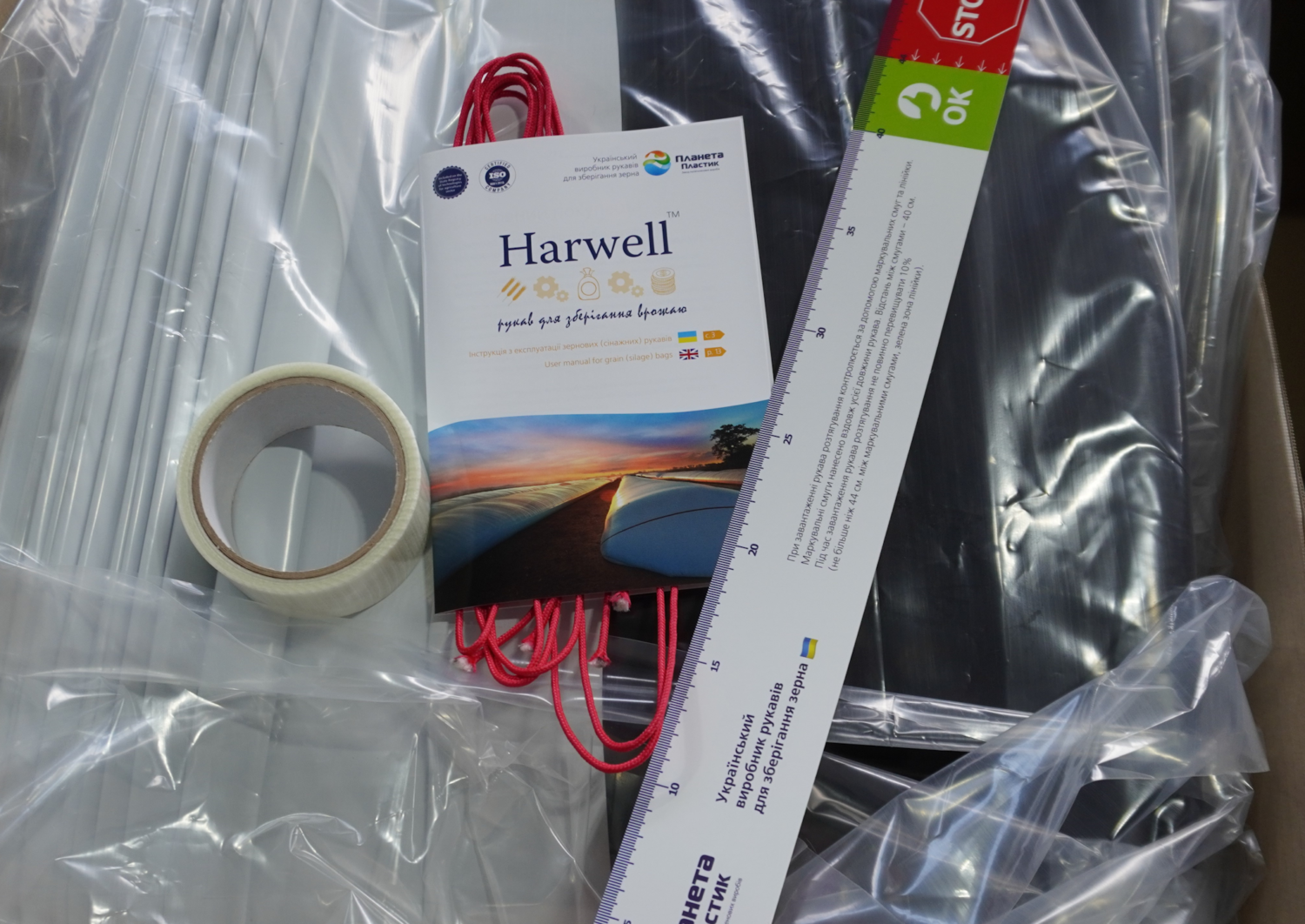
To put it very simply, a grain storage sleeve is a giant polyethylene bag. The most common grain storage sleeve is 60 meters long and 2.7 meters in diameter. With these parameters, the sleeve holds about 200 tons of grain. From the factory, the sleeve is specially packed into a compact box measuring 60x40x120 cm. Each box, in addition to the Harwell TM storage sleeve itself, is completed with instructions, a special measuring ruler (necessary for monitoring sleeve stretching during the loading process), cords for tightly tying the edges of the sleeve, and a special adhesive tape required when taking grain samples. By the way, this packaging method is highly convenient both for transporting Harwell™ sleeves to the loading site and for storing the sleeves themselves in a warehouse.
Loading Grain into a Polymer Sleeve
Before loading grain into polymer sleeves, it is necessary first of all to prepare the site where the harvest will be stored. The surface of the site does not matter—it can be a dirt, concrete, or asphalt area. The main thing is that the site must be level, dry, and completely free of any sharp objects that could mechanically damage the storage sleeve. On the site, the sleeve is “dressed” onto a bagger, which is powered by a tractor or electric motors. One end of the sleeve is tied, after which the grain is fed for loading. In practice, with well-established grain logistics to the storage site, a 200-ton Harwell TM sleeve is loaded in about an hour. A critical step in the sleeve storage technology is monitoring the filling of the sleeve. For this purpose, the Harwell TM sleeve features two parallel lines printed along its entire length on the side section. These lines serve as an indicator of stretching during the loading process. During loading, the stretching of the sleeve must not exceed 10%! The standard level of sleeve loading is controlled using the same special measuring ruler included in the sleeve kit. The packing density is regulated by the braking system of the bagging machine. If the sleeve needs to be filled more tightly, the brakes are tightened. Conversely, for a less dense filling of the sleeve, the brakes are loosened. As a rule, these adjustments occur on the site only once. After filling the sleeve, the second end of the loaded sleeve is tightly tied and covered with soil. The moisture percentage of the product, the loading date, and the grain type can be written on the surface of the loaded sleeve (this information is applied using spray paint or markers).
Unpacking Grain from a Polymer Sleeve
Unpacking grain is also quite simple, but in reverse order: unpacking starts from the end of the sleeve where the loading was finished. The edge of the bag is opened, and then specialized equipment, cutting the sleeve, transfers the grain into a hopper or a truck for transport. It is always mandatory to check the sharpness of the knife blade on the unbagger. The blade must be sharp. A dull blade will cut the sleeve poorly, and it may tear. As a consequence, grain will spill onto the ground, leading to wasted time and extra labor. Often, small farms do not have unloading machinery, so they unpack grain from the sleeves manually—they simply cut the bag and send the grain into trucks using front-end loaders. However, this process takes longer than unpacking with a specialized machine.
Why Farmers Choose Harwell™ Sleeve Storage Technology
Cost-efficiency.
Today, storage in Harwell™ polymer sleeves is the cheapest method of grain storage among all existing technologies.
Rapid deployment.
The technology is very simple and accessible. From the moment a decision is made to the laying of the first sleeve, it takes literally a matter of days.
No capital investments.
You can store thousands of tons of grain without investing millions of dollars in construction or purchasing warehouse real estate.
Separate storage of crops, classes, and varieties.
Grain sleeves allow different crops, varieties, and grain classes to be stored on the same site. If necessary, exactly the grain that is needed at the moment can be extracted.
24/7 harvest control.
Complete access and control over your harvest stored in Harwell™ grain sleeves. At any given moment, you decide what to do with your grain and when.
Harvest safety during wartime.
By using grain sleeves, you can disperse your harvest across different storage sites, which reduces the risks of potential harvest destruction by enemy shelling.
Harwell TM polymer sleeves allow grain to be stored for years without loss of quality, which is particularly important in case of logistics delays. This makes it possible to postpone grain sales until the moment when prices are more favorable. In addition, sleeves allow grain to be stored right at the cultivation site, reducing transportation costs.
